

The Key to a More Efficient Go-To-Market Strategy
Aligning marketing and sales teams has long been critical for achieving predictable growth and consistent results. However, achieving that alignment isn’t always straightforward. One effective way to ensure both teams are working in sync is by implementing a Marketing and Sales Alignment Agreement (also known as a Service-Level Agreement or SLA). This formal agreement bridges gaps between the teams, sets clear expectations, improves communication, and makes your go-to-market (GTM) strategy more efficient.
So, what exactly is a Marketing and Sales Alignment Agreement, and how can it enhance your GTM efforts? Let’s break it down.
What Is a Marketing and Sales Alignment Agreement?
A Marketing and Sales Alignment Agreement is a written contract outlining both teams’ responsibilities, goals, and expectations. It serves as a foundation for collaboration, defining who does what, by when, and how success will be measured.
Rather than relying on vague assumptions or informal processes, the agreement sets clear benchmarks for both marketing and sales. For instance, marketing might generate a certain number of qualified leads each month, while sales commits to following up on those leads within a defined period. This formalized process ensures that each team is accountable and aligned toward a shared goal: driving revenue.
How a Marketing and Sales Agreement Supports GTM Strategy
1. Defining Roles and Responsibilities
One of the most significant benefits of an alignment agreement is that it eliminates confusion by clearly defining roles. This level of clarity reduces inefficiencies and ensures that marketing and sales are focused on the same objectives.
For example, the marketing team knows what qualifies as a Marketing Qualified Lead (MQL), ensuring that only leads that meet specific criteria are passed on to sales. Meanwhile, the sales team understands how quickly they need to respond to leads and how to approach them. This reduces any overlap in efforts and allows both teams to focus on what they do best, streamlining the overall GTM strategy.
2. Ensuring Quality and Efficient Handoff
The quality of leads is a constant source of tension between marketing and sales. Often, marketing believes they’re delivering qualified accounts, but sales may feel those accounts aren’t qualified because they’re not ready to buy. An alignment agreement helps resolve this issue by defining a qualified lead.
By agreeing on what makes a lead “qualified,” both teams are on the same page. Marketing can focus on nurturing leads that are most likely to convert, while sales knows exactly what to expect when they receive those leads. In turn, this alignment creates a smoother handoff process. Marketing sends over leads that meet agreed-upon criteria, and sales commits to following up within a set timeframe, such as 24 hours.
This more defined process minimizes dropped leads, resulting in a more efficient go-to-market strategy and quicker deal closing times.
3. Measuring Performance and Accountability
With a Marketing and Sales Alignment Agreement, both teams are held to specific performance metrics. These Key Performance Indicators (KPIs) help track whether each team is meeting the agreed-upon goals.
Common KPIs could include:
- The number of MQLs generated by marketing
- The conversion rate from MQL to SQL (Sales Qualified Lead)
- Response time from sales once a lead is handed off
- The percentage of SQLs that turn into closed deals
These metrics hold both the marketing and sales teams accountable. If the marketing team falls short on lead volume, it knows where adjustments need to be made, such as revisiting campaign targeting or lead nurturing strategies.
Similarly, if sales isn’t converting leads as expected, they can assess whether their follow-up or outreach methods need improvement.
Having measurable goals also enables leadership to identify and address roadblocks faster, making it easier to fine-tune the GTM approach when needed.
4. Establishing Feedback Loops for Agility
In any GTM strategy, adjusting based on performance data is critical. An alignment agreement helps speed up this process by promoting continuous communication and collaboration between marketing and sales. Regular check-ins between the teams—weekly or bi-weekly—allow for feedback on lead quality, campaign effectiveness, and sales outcomes.
For example, if the sales team notices that a particular type of account is converting at a higher rate, they can quickly share that insight with marketing. Marketing can then refine its targeting or messaging to focus more on similar accounts. Conversely, if certain accounts aren’t performing as expected, sales can provide feedback so that marketing can tweak their approach.
This collaborative feedback loop allows both teams to pivot their strategies quickly, improving the efficiency of your go-to-market efforts and ensuring that your teams are constantly working with the best data available.
Create Your Own Marketing and Sales Alignment Agreement
To develop your Marketing and Sales Alignment Agreement, start with our simplified Go-to-Market Alignment template.
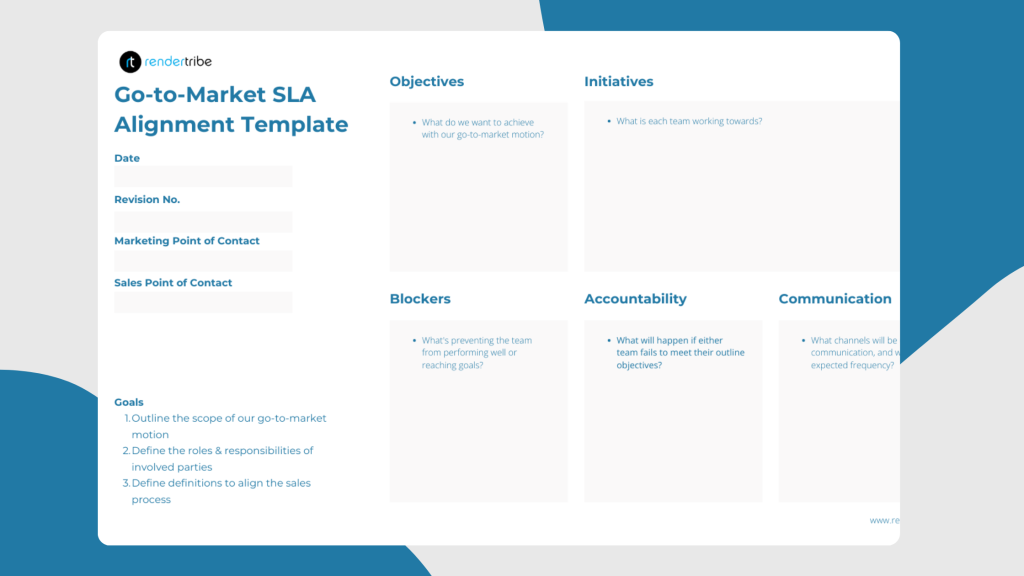
>> Download PowerPoint Version
Final Thoughts
Aligning marketing and sales around a formal agreement can significantly improve the efficiency of your GTM strategy. A well-structured Marketing and Sales Alignment Agreement establishes clear expectations, enhances lead quality, and drives accountability, ultimately leading to better business outcomes.
Companies can create a more streamlined, data-driven approach to reaching their goals by fostering collaboration between both teams. If you haven’t yet implemented an alignment agreement, now is the time to take that step and reap the benefits of a more cohesive go-to-market strategy.
Need some guidance to put your GTM strategy into action? Reach out to RenderTribe today.
